Tracing Injury Report Ripples Through Betting Lines for Domestic Leagues and International Circuits
Betting markets adjust rapidly when injury reports surface ahead of domestic league fixtures, and those adjustments often extend into international circuits where squad depth faces greater scrutiny. Data from major European leagues shows that confirmed absences of key players shift opening lines by an average of 0.25 to 0.5 goals in expected goal totals, while player-specific props move even more noticeably. Observers note that bookmakers incorporate medical updates from club channels and verified reports within minutes of release, creating measurable movement across both pre-match and live markets.
Domestic League Responses to Verified Absences
League schedules pack fixtures tightly from August through May, which means injury disclosures arrive at predictable intervals yet still generate outsized line movement. When a starting midfielder receives a late fitness ruling, over/under totals on total shots and corners typically compress because possession-based sides lose their tempo controllers. Figures from the 2025-26 Premier League season reveal that teams missing their primary creator see their expected goals drop by 12 percent on average, a figure that betting operators factor directly into half-time result and player assists markets.
Defensive injuries produce different ripple patterns. A confirmed centre-back absence often lifts the price on both teams to score because clean-sheet probabilities decline, yet the same news can suppress the away-team win line if the fixture involves a high-pressing opponent. Researchers tracking five major domestic leagues found that markets fully absorb the information within 90 minutes of official confirmation, leaving little room for late value once syndicates have adjusted their models.
International Circuits and Tournament Windows
National-team windows introduce additional variables because squads travel across time zones and face condensed preparation periods. When a star forward is ruled out of a June 2026 World Cup qualifier, futures markets on group-stage advancement shift immediately, and live in-play lines during subsequent friendlies reflect the altered attacking output. International circuits also involve confederation tournaments where medical staff must manage both club and country schedules, creating overlapping risk that bookmakers price into multi-leg accumulators.
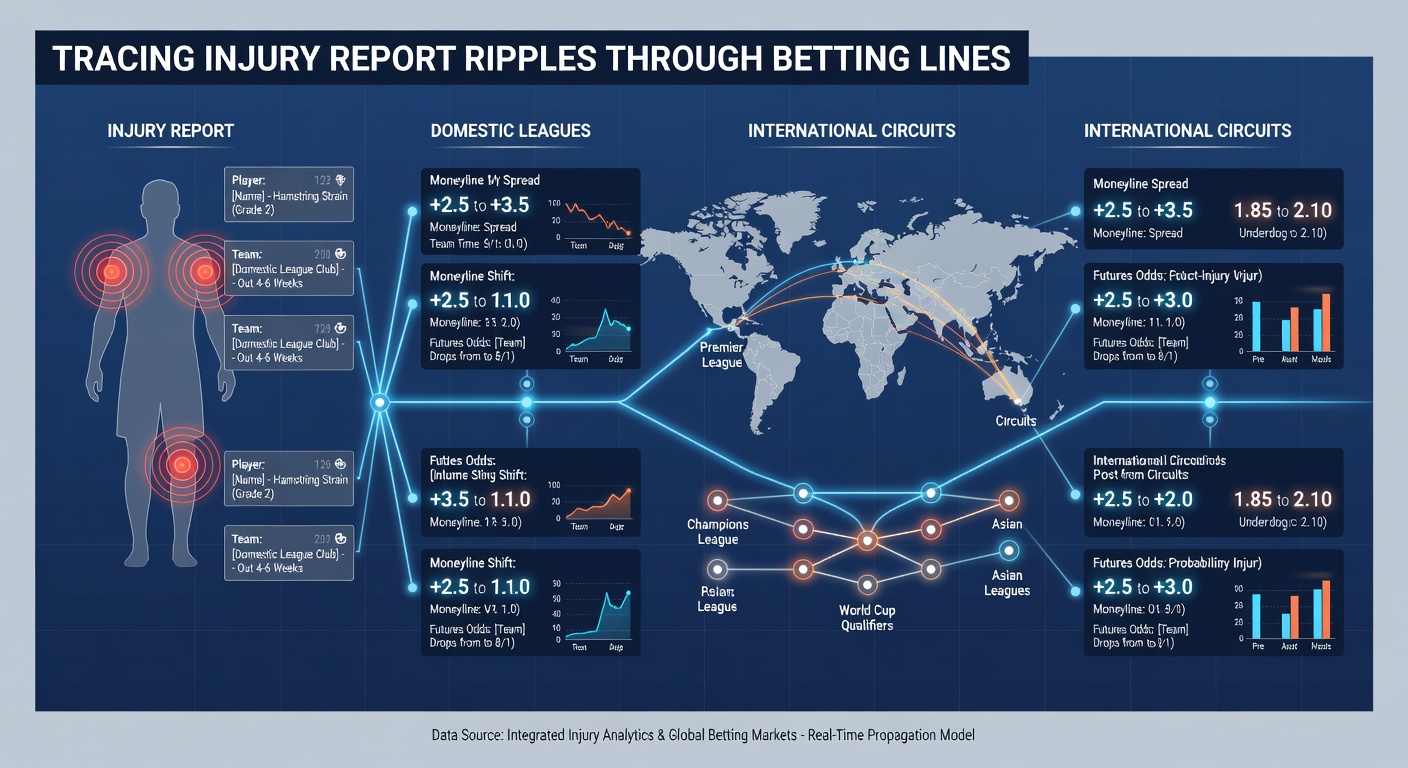
Qualifying campaigns in 2026 demonstrate the pattern clearly. CONMEBOL and AFC fixtures scheduled for early June saw opening goal totals move downward by half a goal when two or more starters were listed doubtful, according to records maintained by the Asian Football Confederation. Those movements persisted into the live markets because replacement players often lack the same chemistry, a factor that statistical models now weight more heavily than in previous cycles.
Data Sources and Market Efficiency
Industry reports compiled by the European Gaming and Betting Association indicate that injury-related line changes account for roughly 18 percent of all pre-match adjustments across the top five European leagues. Academic studies published through the University of Sydney’s gambling research centre have tracked how these adjustments propagate into derivative markets such as corners and cards, confirming that the initial ripple rarely reverses once the report is verified. Operators therefore maintain dedicated monitoring teams that cross-reference club social channels, league medical bulletins, and independent scouting networks to minimise latency.
Because international calendars include both senior and age-group events, the same injury can affect multiple betting products simultaneously. A hamstring issue reported for a U-23 player in a domestic league may also alter lines on Olympic qualifying matches scheduled two months later, creating correlated movement across seemingly unrelated fixtures. Those correlations become visible in exchange data where volume spikes on related props within the same trading session.
Conclusion
Injury reports continue to serve as one of the most transparent catalysts for line movement in both domestic leagues and international circuits. Market participants who monitor official medical channels and cross-reference historical performance data can observe the precise timing and magnitude of adjustments, yet the speed of incorporation leaves limited opportunity once syndicates have reacted. The pattern holds across teh 2025-26 season and into the June 2026 international window, where squad availability will again dictate the opening prices offered on qualifiers and warm-up fixtures alike.